Interns from the ACA member company helped develop an app designed to simplify saving, debt management, and long-term financial planning during a financial literacy-focused hackathon at Winthrop University.
 Interns from the ACA member company helped develop an app designed to simplify saving, debt management, and long-term financial planning during a financial literacy-focused hackathon at Winthrop University.
5/14/2026 3:00 P.M.
Vibe coding. Energy drinks. Rapid-fire brainstorming sessions. New friendships formed over lines of code.
Inside the recent hackathon “LetsBuild 26.3 – Vibe Coding FinTech” held at Winthrop University in South Carolina this past March, students raced against the clock to build technology focused on one very real issue: helping consumers better understand debt, saving and financial literacy.
Organized in collaboration with Microsoft and led in part by Williams & Fudge Chief Technology Officer Jon Balon, the event challenged student teams to use AI to “vibe code” solutions for real-world financial literacy problems.
“The whole goal was to keep the topic super vague — besides setting some ground rules — which we thought allowed for a lot of creativity,” Balon said.
And with that, attendees were off to create apps designed to improve financial literacy and debt management.
Building “Snowball”
There were three winners, with a top prize of $1,000, sponsored by Williams & Fudge. The winning team included Williams & Fudge interns Lou Neal, then a junior, and Lukas Andrews, then a freshman — both computer science majors — who partnered with another Winthrop University student they met at the event.
 Together, the trio developed “Snowball,” an app designed to help users gradually save money, pay down debt and eventually transition into investment planning. The app was inspired by the snowball method often used in personal finance strategies, in which users build momentum through consistent financial progress over time.
Neal and Andrews said the app was developed with college students in mind. As students themselves, they wanted to focus on debt management because it was something they could personally relate to and better understand.
The team designed the app around realistic, everyday savings habits — starting with small changes like cutting back on coffee purchases — to show users how incremental savings can significantly reduce debt and interest over time. Through visual graphs, FAQs and progress tracking, the app helps users better understand how even small weekly contributions can shorten repayment timelines and make large debt amounts feel less overwhelming.
Snowball also transitions users from debt repayment into investing by showing how the same money previously used for debt payments could potentially grow through investments or high-yield savings accounts. The students said the goal was to create a seamless financial journey specifically designed for college students, helping them move from managing debt to building long-term financial habits and wealth.
“People struggle to visualize progress when it comes to debt and saving money,” said Neal. “We wanted to create something that makes financial growth feel achievable and motivating.”
From Hackathon to Business Idea
The team’s work may not stop with the hackathon. Following the competition, the students said they began exploring ways to potentially turn Snowball into a real business venture.
“We are in the process of moving the app into a full-fledged business, and we have a lot of different directions we’ve thought about going,” Neal said. “There are certain key markets we could try to target, but we’re trying to decide which one to start with.”
Neal added that the team hopes to continue refining the app, first focusing on a polished version tailored to one market before potentially expanding features and pivoting into additional opportunities as the platform grows.
Problem-Solving Under Pressure
Andrews said one of the biggest takeaways from the hackathon was learning how to move quickly from an idea to a working product under pressure.
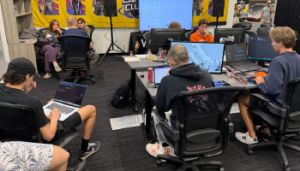 “You only have a limited amount of time, so you have to learn how to prioritize what matters most,” Andrews said. “It really pushes you to collaborate and problem-solve fast.”
More than 15 teams and approximately 60 participants competed in the hackathon, making the team’s first-place finish even more meaningful.
Despite ultimately winning the competition, the group said they initially thought their chances were over after a major issue occurred during the final presentation.
“Our app crashed during the presentation,” said Neal. “But we fixed the issue within about 20 seconds and just kept going.”
The team later learned that the judges viewed the situation as a strength rather than a setback.
“A few of the judges told us the error actually helped us because it showed we could keep moving when faced with problems in a high-stakes environment,” said Neal.
When the team was announced as the winner, Neal said the moment reinforced their belief that the app had potential beyond the competition itself.
“If we could build something in 18 hours that got people excited — even with a malfunction — then maybe it was something worth pursuing,” Neal said.
Encouraging Innovation Through Internships
Balon said the event was designed not only to encourage innovation but also to help students better understand real-world financial challenges and emerging technologies such as artificial intelligence.
“We wanted students to think about how technology can help solve practical financial problems people face every day,” he said.
Throughout the event, students used AI-assisted coding tools to accelerate development, though Neal emphasized the importance of understanding the code being generated rather than relying solely on automation.
“One of the things we talked about throughout the hackathon was that AI can help speed up development, but developers still need to understand what the code is actually doing,” Balon said.
The hackathon also reflected Williams & Fudge’s broader commitment to internships, innovation, and hands-on learning opportunities for students interested in technology and software development.
Balon said giving interns opportunities to work on real projects, collaborate with professionals, and participate in events like hackathons helps prepare them for future careers while strengthening problem-solving and communication skills.
For Neal and Andrews, the hackathon was about more than just winning a competition. It gave them the chance to take what they’ve learned in the classroom and apply it in a real-world, high-pressure environment while creating technology they hope can make a meaningful difference in people’s financial lives.
Remember to subscribe to ACA Daily and Member Alerts under your My ACA Assistant profile when logged in to acainternational.org.