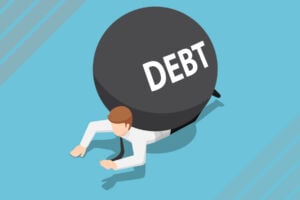
New research uncovers the exact moment when financial stress turns into psychological numbness.
 New research uncovers the exact moment when financial stress turns into psychological numbness.
09/23/2025 12:00 P.M.
3 minute read
Picture this: You’re drowning in $50,000 of debt, losing sleep every night, checking your bank balance obsessively. Now imagine you owe $500,000 — and you’re sleeping like a baby. Sound backwards? Welcome to the psychology of American debt.
New research shows that people don’t just become more stressed as debt piles up. Instead, we hit a psychological circuit breaker at exactly $75,000 to $99,000 in total debt — then we just stop caring.
A JG Wentworth study of 1,186 consumers identified what researchers term “debt numbness” — a psychological state where individuals become cognitively detached from their financial obligations. Stress levels peak at 4.2 out of 5 when total debt reaches that $75,000 to $99,000 sweet spot. However, beyond $500,000, stress drops to just 2.5, even lower than for people carrying a mere $2,500 in debt.
Meanwhile, the National Foundation for Credit Counseling’s latest survey shows a concerning acceleration in risky financial behaviors. Since spring, 53% of Americans have watched their finances deteriorate — up from 49% just months ago. And the number of people making less than minimum credit card payments has jumped from 8% to 13% in just a few months.
“The increase in detrimental behaviors and negative attitudes underscores the persistent financial pressure facing households, which also foreshadows potential increases in delinquencies and defaults in the months ahead,” said Bruce McClary, NFCC spokesperson.
Perhaps most concerning is the emergence of widespread financial avoidance behaviors. The research shows that 50% of consumers actively avoid reviewing their bank statements, while 47% report daily anxiety about their debt obligations.
This creates a paradox where those most in need of financial engagement are least likely to participate in traditional financial management behaviors.
Credit Cards are the Stress Champions
With credit card debt hitting $1.21 trillion, credit cards have become the ultimate stress delivery system. The JG Wentworth study reported: “When considering credit card debt by an increase in fixed dollar amounts, the data shows that stress intensifies until reaching a maximum at 4 out of 5 when the debts have increased by $30,000, at which point the stress levels decline.”
Interestingly, when considering debt overall, 54.6% of people say they feel ashamed about their debt, yet 53.4% find comfort knowing debt is “normal.”
BNPL Stress Trends
The JG Wentworth research reveals some concerning trends around buy now, pay later (BNPL) services.
Unlike other debt categories that show earlier stress plateaus, BNPL debt maintains a steady upward stress trajectory, reaching 3.8 out of 5 when additional debt accumulates to $10,000. Starting with the highest initial stress level at 3.0 for just a $500 increase, BNPL appears to trigger immediate psychological stress despite its marketing as a low-risk payment option.
This finding is particularly significant given Federal Reserve data showing that one in four BNPL users made a late payment in 2024, up from 18% the previous year.
Generational Attitudes Vary
The generational divide in debt stress is stark. Nearly half of Gen Z (18-26) reports minimal debt stress. Meanwhile, 23.2% of Americans aged 43-59 are at maximum stress levels, suggesting that financial anxiety peaks right when you realize that the retirement you hoped for may not happen. More than half of consumers worry about not having enough money to live on when they are older.
Additionally, 29% of Americans now believe their money situation will prevent them from ever having what they want (up from 26% in the spring).
Read the JG Wentworth study here.
Read the NFCC survey highlights here.
Related Content from ACA International:
Household Finances Show Mixed Signals for ARM Industry
Remember, subscribe to ACA Daily and Member Alerts under your My ACA Assistant profile when logged in to acainternational.org.