The updated Core Curriculum course helps ARM professionals move beyond surface-level fixes and address the operational, compliance and technology issues driving repeat problems.
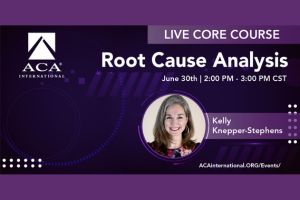 The updated Core Curriculum course helps ARM professionals move beyond surface-level fixes and address the operational, compliance and technology issues driving repeat problems.
06/25/2026
Repeat problems can drain time, resources and energy from any organization. For accounts receivable management professionals, finding the true source of a recurring issue can be key to improving operations, strengthening compliance and supporting better outcomes for consumers and clients.
ACA International’s updated Root Cause Analysis Core Curriculum Course is designed to help members examine how problems develop, why they happen and what steps teams can take to address them more effectively.
Adapted from ACA’s Blueprint® system, the course walks learners through the root cause analysis process, helping them move beyond surface-level issues to better understand the underlying reasons a known problem occurred.
Why Root Cause Analysis Matters Now
“The collection industry has evolved rapidly over the last few years,” said Kelly Knepper-Stephens, chief legal officer at TrueML Technologies and instructor for the Root Cause Analysis Core Curriculum Course. “With shifting regulatory expectations, state-specific mandates, increased reliance on automated dialing and omnichannel technologies, and tighter operational margins, yesterday’s troubleshooting methods no longer cut it.”
Knepper-Stephens said modern collection issues are rarely isolated mistakes. More often, they involve complex interactions among compliance requirements, technology workflows, data, processes and human behavior.
For agencies, that makes root cause analysis especially important.
“In accounts receivable management, agencies operate in a high-volume, high-risk environment,” Knepper-Stephens said. “Every day, they handle thousands of data points, automated processes and direct consumer interactions. If a problem occurs, such as a compliance slip or a broken payment pipeline, treating only the surface issue may temporarily mask the problem, but the underlying issue remains.”
Root cause analysis provides teams with a framework to identify the actual drivers of a problem so they can address it at the source. That process can be especially valuable when agencies are dealing with recurring challenges related to operations, quality control, compliance, client expectations or the consumer experience.
Moving Beyond Surface-Level Fixes
Knepper-Stephens said that deeper analysis can prevent agencies from defaulting to the easiest explanation.
“Looking only at the surface usually leads to blaming the easiest target,” she said. “For example, if an email is sent before 8 a.m. in a consumer’s time zone, the surface-level fix may be to reprimand or retrain the employee. But a deeper review might reveal that the compliance logic failed or that a system did not update information used to calculate the correct time zone. If you do not look beyond the surface, the real technical or structural vulnerability remains open.”
Root cause analysis can help agencies better understand and resolve repeat problems such as recurring third-party disclosure errors, spikes in disputes, broken promise-to-pay agreements, declining liquidation rates, data formatting mismatches during client portfolio imports, performance dips or high employee turnover.
What Learners Will Take Away
According to Knepper-Stephens, the updated curriculum provides additional insights into the theories behind longstanding root cause analysis tools, including the “5 Whys” technique, which was developed as part of Toyota’s production system. Learners will also be introduced to practical tools and frameworks designed to support a more structured problem-solving process.
Among the additions are:
- Logic tree analysis: a visual methodology that helps learners break down a high-level failure into clear branches so potential failure pathways are not overlooked.
- The actionability test: which helps teams focus on internal vulnerabilities they can address rather than external factors they cannot control.
- The chain collapse test: which helps learners determine whether they have identified a symptom or the true root cause.
The course also helps participants move from identifying a known problem to understanding why it happened. Learners will examine how to correctly identify a problem, determine why it occurred, categorize the reasons behind it and analyze the results of asking “why.” They will also learn how to determine whether those reasons are the cause or result of the known problem.
“We want learners to walk back into their offices with a practical blueprint for root cause identification,” Knepper-Stephens said. “They should be able to facilitate a root cause analysis session, build a visual fault tree or fishbone diagram for a complex operational issue and confidently apply the framework.”
Who Should Take the Course
The course may be especially helpful for compliance officers, quality assurance managers, operations and IT leaders, trainers, supervisors and executive leaders. It is also relevant for anyone involved in solving problems, improving processes or protecting an agency’s operations.
The course takes approximately 1.5 hours to complete and offers 1.5 Professional Development Unit points. There are no recommended prerequisites.
Knepper-Stephens said now is an important time for members to strengthen this skill as new technologies, including artificial intelligence, continue to change the workplace and present new operational and compliance considerations.
“Clients and regulators expect comprehensive compliance management systems that identify the true root causes of problems and support systemic controls,” she said. “This updated course gives teams modern tools to turn operational mistakes into opportunities for stronger, more sustainable improvement.”
For members looking to strengthen internal problem-solving and reduce recurring challenges, the updated Root Cause Analysis Core Curriculum Course offers a practical starting point.
Visit ACA’s Store to explore additional training opportunities and professional development courses.
Remember, subscribe to ACA Daily and Member Alerts under your My ACA profile when logged in to acainternational.org.