The Trainer Specialist Designation Workshop, held in three 90-minute sessions Sept. 22-24, 2026, will help you turn industry requirements into training that employees can understand, remember, and apply.
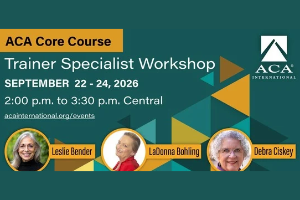 The Trainer Specialist Designation Workshop, held in three 90-minute sessions Sept. 22-24, 2026, will help you turn industry requirements into training that employees can understand, remember, and apply.
09/14/2026 3:00 P.M.
Strong training can shape everything from an employee’s confidence and performance to an organization’s consistency and compliance posture.
For members who want to build on that foundation — or take their training programs to the next level — ACA International’s Trainer Specialist Designation Workshop, held Sept. 22–24, 2026, offers the tools to do it.
The live webinar runs from 2 to 3:30 p.m. CT each of the three days and is available exclusively to ACA members. Participants who complete the workshop will earn ACA’s Trainer Specialist designation and receive the association’s official Essentials training kit. The kit can be used to onboard new employees, retrain current staff, and prepare team members for the Professional Collection Specialist exam.
The workshop is divided into three sessions covering adult-learning principles and training techniques, FDCPA Essentials for the ARM Industry, and Essential Collection Skills and Techniques. Together, the sessions will help participants better understand not only what information their employees need, but also how to deliver it in a way that supports learning and retention.
Making Training Memorable
During the first session, Debra Ciskey, senior compliance advisor at ARM Compliance Business Solutions, will discuss the needs and motivations of adult learners, as well as 10 foundational elements trainers can use to make learning memorable and actionable.
Ciskey said organizations often select exemplary employees as trainers because they do their job well, but those employees may have little experience teaching others.
Teaching training skills once and then moving on rarely gives employees enough time to understand and apply them properly, she said. Compounding that challenge, management often underestimates the time required for effective training.
The 90-minute workshop sessions in September will help trainers take a closer look at the content and pacing of their own programs, identify the “need-to-know” skills, and ensure employees have learned them.
That investment can help employees become productive more quickly, Ciskey said. It can also help them understand the reasons behind policies and procedures — an increasingly important skill as ARM organizations navigate regulatory changes, heightened state scrutiny, and consumer misinformation.
“The regulatory environment we work in today is more chaotic than ever,” Ciskey said. “With pressure coming in from all directions, our front-line collection staff, our correspondence handlers, our dispute and complaint handlers, and even our salespeople and IT professionals have to understand the ‘why’ behind the ‘what’ (what we are doing and why we are doing it) to ensure that policies and procedures are performed fully, accurately, and in compliance with our policies.”
Turning Compliance Requirements into Action
Leslie Bender, senior counsel at Eversheds Sutherland, will lead the second portion of the workshop, focusing on translating the FDCPA and Regulation F into concepts that collections trainers can teach effectively.
“Effective training is not just about conveying information; it is about shaping culture and influencing how collectors respond when they must recall and apply compliance principles,” Bender said.
She noted that collectors are often trained to expect certain reactions from consumers, but in doing so, they may miss the chance to hear the underlying circumstances that have prevented an account from being resolved.
To counter that mindset, participants will learn consumer-centered strategies for translating technical requirements into clear behaviors, coaching conversations, and scenario-based exercises. Bender will also discuss how trainers can approach learning from the employee’s “What’s in it for me?” perspective by connecting compliance content to the challenges collectors experience each day.
“When trainers connect training content to the practical benefits and challenges collectors experience every day, engagement and retention improve significantly,” she said.
Effective training can also help employees view themselves as problem-solvers who use empathy, professionalism, and sound judgment to help consumers find realistic paths to resolution, Bender said.
The Human Side of the Conversation
LaDonna Bohling, chief compliance officer at Contract Callers, Inc., will teach the final session, which focuses on Essential Collection Skills and the human side of consumer communication.
“We can teach someone the FDCPA, policies and procedures, but that doesn’t necessarily teach them how to have an effective conversation with a consumer,” Bohling said.
Her session will cover listening, questioning, tone, empathy and negotiation, along with ways collectors can maintain control of a call without making the consumer feel controlled.
One technique participants will learn — and can use right away — is mirroring: repeating a few important words the consumer used, then pausing to invite them to continue and elaborate, Ciskey said.
For example, if a consumer says, “I can’t pay that because I just went back to work,” the collector could respond, “Just went back to work?” and then stop talking.
“That silence is often where the useful information comes from,” Bohling said.
The approach requires collectors to listen rather than wait for their turn to speak and can encourage consumers to share information that may help identify a solution.
According to Bohling, this kind of application is what separates information delivery from real training. Employees need opportunities to practice, make mistakes, receive feedback, and understand why they are being asked to handle conversations in a certain way.
As technology and communication channels continue to evolve, consistent training helps employees develop the judgment to know when to listen more carefully, ask another question, slow down a conversation, escalate an issue, or recognize a compliance risk.
“Ultimately, training protects three things at the same time: the consumer, the organization and the client’s brand,” Bohling said. “That’s why it can’t be something we do during onboarding and then consider finished.”
Training, she added, isn’t an event — it is an operating discipline.
The Takeaway
For ARM organizations, developing a skilled in-house trainer pays dividends well beyond a single onboarding cycle. It gives employees a dedicated resource who understands both the organization’s standards and the industry’s expectations — someone who can answer questions, reinforce good habits, and help the team stay ahead of compliance changes.
Whether you have been training employees for years or are stepping into that role for the first time, the workshop offers practical tools, techniques, and resources you can bring directly back to your team.